

 English
 Español

Content
- 1 Why "Just Measure the Bar" Isn't Enough for STIHL
- 2 Reading the Part Number Stamped on Your STIHL Bar
- 3 Measuring Cutting Length the Standard Way
- 4 Confirming True Bar Length for a Replacement Order
- 5 STIHL's Three Mount Sizes: Small, Medium, and Large
- 6 Matching Pitch and Gauge to Your STIHL Chain
- 7 Ordering the Right Replacement Bar
Why "Just Measure the Bar" Isn't Enough for STIHL
Grab a tape measure, run it along the bar, and you'd think that settles it. For most tools, it would. For a STIHL chainsaw, length is only one piece of the puzzle. A replacement bar also has to match the saw's mount, the specific slot-and-stud arrangement where the bar attaches to the powerhead, and STIHL uses three different mount sizes across its lineup. Get the length right but the mount wrong, and the bar simply won't fit.
STIHL documents its own guide bar systems, including the Rollomatic and Ematic lubrication designs, on its official service pages, which is a useful reference point when you're trying to confirm exactly what you're working with. The company's overview of its guide bar systems and mount compatibility is worth a look before you order anything.
Reading the Part Number Stamped on Your STIHL Bar
The fastest way to identify a STIHL bar isn't a tape measure at all. It's the part number stamped into the metal near the tail of the bar, usually a sequence like 3005 000 4817. The first four digits tell you the mount size, the middle digits typically indicate country of origin, and the final digits are the specific part number within that mount family.
If the stamp is worn or unreadable, this is where physical measurement becomes necessary. But whenever the number is legible, it's the single most reliable shortcut to identifying a correct replacement, since it skips the guesswork that comes with measuring slots and studs by hand.
Measuring Cutting Length the Standard Way
When the part number isn't available, cutting length is the next thing to confirm. With the bar mounted on the saw, measure from the tip of the bar straight back to the point where it enters the chainsaw's body, then round that figure up to the nearest even number. A measurement of 17 inches becomes an 18-inch bar; STIHL, like other manufacturers, only sells in even-numbered lengths.
This method is standard across the industry, not unique to STIHL, so if you want the complete walkthrough with more detail on technique and common measuring mistakes, the full step-by-step method for measuring cutting length on any chainsaw covers it thoroughly.
Confirming True Bar Length for a Replacement Order
Cutting length gets you close, but it's a rounded, marketing-friendly number rather than a precise one. If you want an exact match, particularly when ordering online without being able to test-fit the bar first, true bar length is the more reliable figure. That requires removing the bar from the saw and measuring it end to end on a flat surface, without rounding.
The gap between called length and true length is well documented among STIHL owners, since 3/8-inch low-profile and .325-inch small-mount bars in particular tend to measure shorter than their labeled size once removed. For the mechanics of that distinction and why it matters for ordering, a detailed breakdown of cutting length versus true bar length walks through both measurements side by side.
STIHL's Three Mount Sizes: Small, Medium, and Large
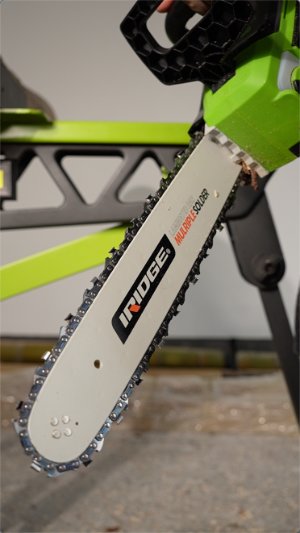
STIHL bars come in three mount sizes, and they are not interchangeable. The small mount, coded 3005, fits most compact and homeowner-grade saws. The medium mount, 3003, is the most widely used across STIHL's mid-range gas saws, including popular models in the Farm Boss line. The large mount, 3002, is reserved for bigger, higher-displacement saws built for heavier felling and milling work.
If you don't have a legible part number to reference, measuring the width of the mounting slot with calipers, or the diameter of the studs on the saw itself, will tell you which of the three categories you're working with. Mixing them up is a common and completely avoidable mistake, since a bar with the wrong mount size won't seat properly no matter how close the length is.
Matching Pitch and Gauge to Your STIHL Chain
Bar length and mount size only solve half the fitting problem. The chain has to match the bar's pitch, the distance between drive links, and gauge, the thickness of the drive link that sits in the bar's groove. Getting either of these wrong means the chain either won't seat in the groove or won't engage the drive sprocket correctly, regardless of how well the bar itself fits the saw.
Pitch and gauge measurement deserves its own careful process, and a complete guide to measuring chain pitch, gauge, and drive link count covers the tools and techniques in full. Once you know your specifications, you can browse the full range of chainsaw chains by pitch to find a match.
Ordering the Right Replacement Bar
Put together, a correct STIHL bar order comes down to four confirmed details: mount size, cutting length, pitch, and gauge. Skipping any one of them is the most common reason a replacement bar arrives and doesn't fit, even when the length looked right on paper.
With those four specifications in hand, ordering becomes straightforward rather than a guessing game. For buyers ready to compare options once their measurements are confirmed, a range of guide bars across all three mount sizes makes it easier to match a replacement to the exact specification a STIHL saw requires.

