

 English
 Español

Measuring your chainsaw bar length gets you halfway to a correct replacement. The other half — the part most people skip — is matching the chain's pitch, gauge, and drive link count to that bar. Miss any one of those numbers and the chain won't fit, won't run safely, or won't last. Here's how to get all of them right.
Content
Bar Length Is Just the Starting Point
A chainsaw's cutting system has two components that must work together precisely: the guide bar and the chain. The bar length tells you how long your cutting path is, but it says nothing about whether a given chain will actually seat and run correctly on that bar.
Chain compatibility depends on three separate specifications: pitch (the spacing between drive links), gauge (the thickness of each drive link), and the number of drive links in the chain. All three must match your bar exactly. A chain with the right pitch but wrong gauge will either sit too loosely in the groove — a derailment risk — or bind so tightly it causes overheating and accelerated wear.
The good news: measuring these values yourself is straightforward, and it takes less than ten minutes even without special tools.
How to Measure Chainsaw Bar Length (Quick Recap)
Before tackling the chain specs, confirm your bar's called length. With the saw powered off and the spark plug wire or battery disconnected, place a tape measure from the tip of the bar to the point where the bar meets the chainsaw body. Round the result up to the nearest even inch. That number is your bar's called length — the figure used in all replacement bar and chain specs.
If your bar still has legible markings near the mounting end, the called length and chain specs may already be stamped there. Check before measuring — it can save several steps.
How to Measure Chain Pitch
Pitch describes the spacing between the chain's drive links. The standard way to measure it: identify any three consecutive rivets on the chain, measure the distance between the first and the third, then divide that number by two.
For example, if three consecutive rivets span 3/4 of an inch, your chain pitch is 3/8 inch. This two-step approach — measure across three rivets, divide by two — accounts for the alternating link pattern and gives you the true per-link spacing.
Common pitch values you're likely to encounter:
- 3/8 LP (Low Profile) — The most common pitch for lightweight and battery-powered saws. Paired with smaller, less powerful powerheads. See 3/8 LP pitch chainsaw chains for lightweight saws.
- .325 inch — A mid-range pitch found on many mid-size gas saws, offering a balance between cutting speed and chain aggressiveness. Browse .325 pitch chainsaw chains.
- 3/8 inch (full) — The standard pitch for professional-grade and high-displacement saws. Higher chain mass and more aggressive cutting. Explore 3/8 pitch chainsaw chains for professional use.
- .404 inch — Heavy-duty industrial and milling applications. Requires high-torque engines to drive effectively.
The pitch of your chain must match the pitch of your bar's sprocket nose. A mismatch causes the chain to skip, jam, or skip teeth — none of which are safe outcomes.
How to Measure Chain Gauge
Gauge is the thickness of the drive links — the tangs that ride inside the bar groove. It must match the groove width of your bar precisely. Too thin, and the chain rattles and risks derailing. Too thick, and the chain binds, generating heat and causing rapid wear to both the bar and the chain.
The most accurate measurement method uses a dial caliper: open the jaws, seat a single drive link between them, and read the measurement. Common gauge values are .043", .050", .058", and .063", with .050" and .058" being the most frequently encountered on residential and professional saws respectively.
If you don't have calipers, the coin method works as a close approximation. Clean out the bar groove with a screwdriver or pick to remove any buildup, then try sliding a quarter, dime, and penny into the groove one at a time — without forcing any of them:
- Quarter fits snugly → .063" gauge
- Dime fits snugly → .058" gauge
- Penny fits snugly → .050" gauge (approximate)
The coin that fits without play but without forcing is your gauge match. This method isn't precise to the thousandth of an inch, but it's accurate enough for selecting a replacement chain.
How to Count Drive Links
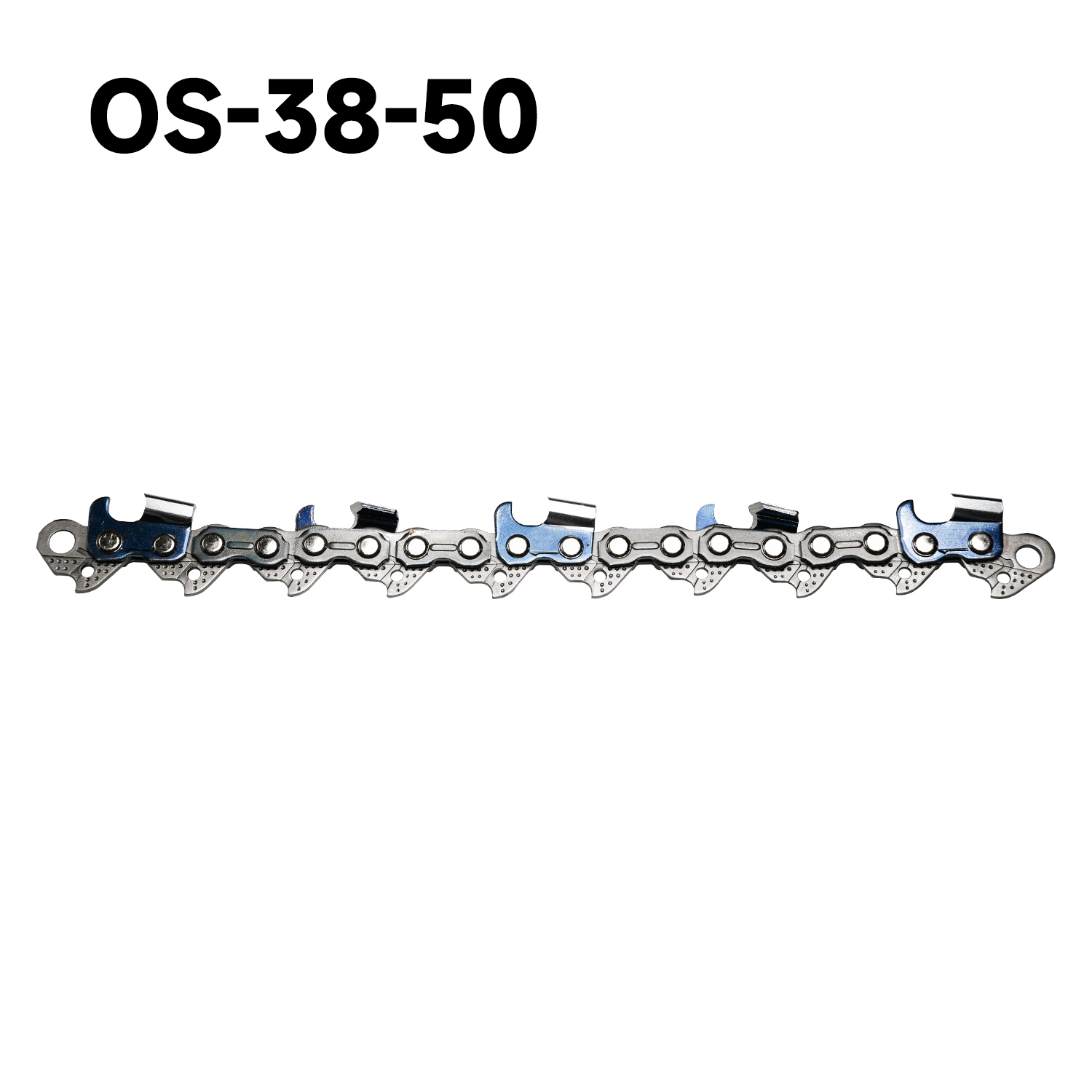
Drive links are the inward-facing teeth on the underside of the chain — the ones that ride in the bar groove and engage with the sprocket. The total count determines how long the chain is and whether it will fit correctly around your bar without being too slack or too tight.
To count them, remove the chain from the bar and lay it flat on a clean surface with the drive links facing up. Starting at any link, count each individual drive link around the full loop until you return to where you started. Count carefully and in one direction — it's easy to lose track on longer chains. A common approach: count in pairs, moving one link at a time with your fingertip to keep your place.
Standard drive link counts for common bar lengths:
| Bar Length | Approx. Drive Links (3/8 LP) | Approx. Drive Links (3/8 Full) |
|---|---|---|
| 12 inches | 44–45 | — |
| 14 inches | 52–53 | 52 |
| 16 inches | 57–59 | 56–57 |
| 18 inches | 62–63 | 62 |
| 20 inches | 72 | 66–72 |
These figures vary by manufacturer and pitch, so always use your actual count rather than assuming from the table. Many bars have the drive link count printed near the mounting area as well.
Putting It All Together: Matching Bar and Chain
Once you have all four numbers — called bar length, pitch, gauge, and drive link count — finding the right replacement chain is straightforward. Reputable chain manufacturers list compatibility by all four parameters, so there's no guesswork involved.
A few final checks before ordering: confirm that the chain's pitch matches your bar's sprocket nose pitch (they must be identical), and verify that the gauge matches the bar groove width. If you measured the gauge with coins and aren't fully confident in the result, a local dealer can confirm the spec in seconds with proper calipers.
For a chain to run correctly, all three parameters — pitch, gauge, and drive link count — must be matched simultaneously. Getting two out of three right still means the chain won't work. Take your time with each measurement, and the replacement process becomes straightforward.
Browse the full chainsaw chain selection organized by pitch to find the exact match for your bar and powerhead combination.

