

 English
 Español

A wrong-sized guide bar doesn't just perform poorly — it creates serious safety risks. Measuring your chainsaw bar length correctly before buying a replacement is one of the simplest things you can do to protect your equipment, your wallet, and yourself.
Content
Why Bar Length Measurement Matters
Bar length directly affects how your chainsaw handles. A bar that's too long for your engine strains the motor, reduces chain speed, and dramatically increases the risk of dangerous kickback. A bar that's too short limits what you can cut and may cause binding. Using the wrong guide bar size can void your warranty and create unsafe operating conditions.
Beyond safety, the right measurement saves money. Chainsaw bars and replacement chains are sold by specific sizes, and even a half-inch error can mean returning parts or ordering again. Getting the number right the first time is worth the two minutes it takes.
Two Types of Chainsaw Bar Length: Called vs. True
There are two distinct bar length measurements, and confusing them is the most common mistake people make when shopping for replacements.
The called length — also known as the effective cutting length or usable length — is the measurement you actually need for replacement purposes. It's the distance from the tip of the bar to the point where the bar enters the chainsaw housing. This is what manufacturers use when they say a chainsaw has a "16-inch bar" or an "18-inch bar."
The true length is the full end-to-end measurement of the bar when it's completely removed from the saw. This number is always a few inches longer than the called length because it includes the portion hidden inside the chainsaw body. Unless you're ordering a very specific OEM part, the true length is rarely what you need.
For the vast majority of bar replacements, measuring and using the called length is correct.
How to Measure Chainsaw Bar Length: Step-by-Step
You do not need to disassemble your chainsaw to get the called length. Here's the straightforward method:
- Power down and secure the saw. Turn off the ignition, disconnect the spark plug wire (on gas models), or remove the battery (on electric models). Place the chainsaw on a flat, stable surface.
- Identify the two reference points. The starting point is the tip of the bar — the rounded nose at the far end. The ending point is where the bar exits the chainsaw housing, at the saw's body.
- Measure with a tape measure. Run the tape along the flat edge of the bar (not along the chain teeth) from the tip straight back to where the bar meets the chainsaw body. Read the measurement in inches.
- Round up to the nearest even inch. Chainsaw bars are only manufactured and sold in even-inch increments. A measurement of 15.5 inches becomes a 16-inch bar. A measurement of 17.25 inches becomes an 18-inch bar. Always round up, not down.
That's your called length — the number you'll use when ordering a replacement guide bar or chain.
How to Read the Bar Label (The Shortcut Method)
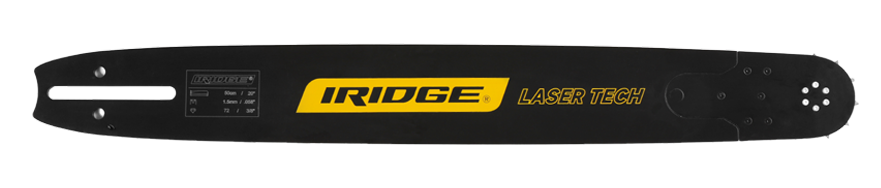
Before reaching for the tape measure, check the bar itself. Most manufacturers stamp or engrave key specifications directly onto the guide bar near the mounting area — the section closest to the chainsaw body.
These markings typically include the bar's called length, chain pitch, chain gauge, and sometimes the number of drive links. On many bars, the length is printed clearly in inches. If the numbers are visible and legible, you can skip measuring entirely and use these figures directly when ordering replacements.
Keep in mind that on heavily used bars, these markings can wear away or become difficult to read. If the label is unclear, fall back on the tape measure method. You can also check your chainsaw's owner's manual or look up your model number online — the manufacturer's specifications will list the recommended bar length.
Chainsaw Bar Length by Application
Once you have your measurement, it helps to know whether the size makes sense for your intended work. Here's a general reference:
| Bar Length | Best For | Typical User |
|---|---|---|
| 10–13 inches | Pruning, light limbing, small branches | Homeowner, occasional use |
| 14–16 inches | Firewood cutting, medium tree felling | Homeowner, general purpose |
| 18–20 inches | Larger tree felling, storm cleanup | Semi-professional, frequent use |
| 24–30 inches | Large timber, professional logging | Professional, heavy-duty use |
| 36 inches and above | Milling, massive timber felling | Commercial/industrial use |
As a practical rule, your bar should be at least two inches longer than the diameter of the wood you're cutting most often. Never exceed the maximum bar length recommended by your chainsaw's manufacturer — longer bars require more torque than smaller engines can safely deliver.
What to Do After Measuring: Buying the Right Replacement Bar
With your called length in hand, you're ready to shop for a replacement. Bar length alone, however, isn't enough — you also need to match the chain pitch and gauge to ensure the new bar works with your existing chain and sprocket system. These specs are usually stamped on your current bar or listed in your owner's manual.
Guide bars also come in different construction types, each suited to different demands. hardnose guide bars for heavy-duty cutting are solid steel from tip to tail, making them extremely durable for demanding professional work where bar damage is a real concern. For most applications, replaceable sprocket nose guide bars offer the advantage of extending overall bar life — when the nose sprocket wears out, you replace just that component rather than the entire bar. Laminated guide bars balance weight reduction with strength, making them a solid choice for users who value maneuverability without sacrificing durability.
Browse the full range of chainsaw guide bars to find the right match for your measurement and cutting application. When in doubt, bring your old bar to a dealer — a physical comparison eliminates guesswork entirely.

