

 English
 Español

Pick the wrong bar length and you'll feel it immediately — the saw bogs down, the cut wanders, or you're making three passes where one should do. Bar sizing is one of those decisions that looks simple on paper but trips up even experienced operators. This guide cuts through the noise: how to measure what you have, which length matches your engine and your task, and what the other specs on the label actually mean.
Content
What Chainsaw Bar Size Actually Means
The number stamped on a chainsaw bar — 16", 18", 20" — does not describe the bar's total physical length. It describes the effective cutting length, sometimes called the "called length": the distance from the point where the bar exits the saw's housing to the very tip. Roughly 2–4 inches of the bar's tail sit hidden inside the casing, clamped to the powerhead.
Why does this matter? Because when you go shopping for a replacement bar or a new chain, the listed size is always the cutting length, not the overall length. A bar listed as 18" may measure 20–22" end to end when you pull it off the saw. If you measure the whole thing and order by that number, you'll end up with the wrong part. Always measure from the housing exit point to the tip.
Manufacturers also sometimes list a "recommended bar length" in the owner's manual that differs slightly from what ships on the saw. That recommended range — not the factory-installed length — is the definitive reference for safe upgrades or replacements.
How to Measure Your Chainsaw Bar
There are three reliable ways to determine your bar's effective length, and it's worth cross-checking with at least two of them before ordering parts.
Tape measure method (fastest): With the saw off and the chain brake engaged, locate the exact point where the bar emerges from the saw body. Run a tape measure in a straight line along the top of the bar to the tip. Note the figure, then round up to the nearest even inch — bars are manufactured in even-inch increments (14", 16", 18", 20", and so on), so a measurement of 17.5" means you have an 18" bar.
Drive link count (most precise): Remove the chain and count the drive links — the hooked teeth that ride inside the bar groove. Cross-reference that count with a chain compatibility chart for your pitch and gauge. This method removes any ambiguity caused by wear or measurement angle.
Bar label or manual lookup: Many bars have the length stamped near the mounting tail, underneath the chain. If the number is legible, that's your fastest answer. Your saw's owner's manual will also specify the bar length and the acceptable range for upgrades.
Complete Chainsaw Bar Size Chart by Use Case
Bar length is fundamentally about matching cutting depth to task. A bar that's too short wastes multiple passes; one that's too long creates unnecessary fatigue and kickback risk. Here's how the standard size ranges break down:
| Bar Length | Typical User | Best For | Typical Engine Size |
|---|---|---|---|
| 10"–14" | Homeowner, arborist | Limbing, pruning, tight overhead cuts | 25–35cc |
| 16"–18" | Homeowner, part-time user | Firewood processing, small tree felling, storm cleanup | 35–50cc |
| 18"–20" | Serious homeowner, farmer | Medium logs, felling trees up to 16"–18" diameter | 45–60cc |
| 20"–24" | Semi-professional, land clearing | Large-diameter felling and bucking, hardwood processing | 55–80cc |
| 24"–36"+ | Professional logger, mill operator | Timber harvesting, Alaskan milling, large softwood and hardwood | 80cc+ |
The rule of thumb most professionals use: your bar should be at least 2 inches longer than the diameter of the wood you're cutting most often. Cutting a 14" log with a 14" bar means you'll need a second pass — feasible but slow. A 16" bar handles it cleanly in one pass with room to spare.
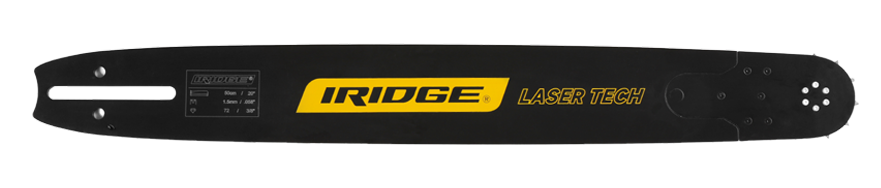
For heavy professional work, hardnose guide bars designed for high-load cutting applications offer greater durability and heat resistance under sustained use compared to sprocket-nose designs.
Matching Bar Length to Engine Power
Bar length and engine displacement are a paired system — one cannot be changed without accounting for the other. The chain travels around the bar at high speed, and every additional inch of bar demands more power to keep it moving at full cutting speed. When the bar outpaces the engine, the chain slows under load, cut quality drops, and the powerhead overheats.
The reverse problem is less obvious but equally real. An undersized bar on a high-displacement saw wastes the engine's potential, generates excessive vibration, and can accelerate chain wear because the chain is running faster than the task requires.
Bar length also affects kickback risk. Longer bars increase the arc of the kickback zone at the bar tip. According to OSHA's chainsaw safety guidelines for logging operations, avoiding contact with the bar tip and maintaining proper chain tension are two of the most effective ways to prevent kickback — both become harder to manage as bar length increases beyond the saw's designed range.
For operators looking to balance power and control, replaceable sprocket nose guide bars allow worn tip assemblies to be swapped out independently, extending bar life without replacing the entire unit — a practical choice when running a saw at the upper end of its recommended bar range.
Key Bar Specs Beyond Length: Pitch, Gauge, and Groove
Bar length is the most visible spec, but it's not the only one that determines compatibility. Three additional measurements govern whether a chain fits a bar correctly — and getting any one of them wrong means the chain won't seat, tension, or cut properly.
Pitch refers to the spacing between chain drive links — technically measured as half the distance between three consecutive rivets. Common pitch sizes are:
- 1/4" — small top-handle and pruning saws
- .325" — mid-range consumer and semi-professional saws; finer cutting, lower vibration
- 3/8" LP (low-profile) — entry-level homeowner saws; designed for reduced kickback
- 3/8" — the most common professional pitch; strong balance of speed and cut quality
- .404" — high-power professional and harvester applications; aggressive cutting rate
Pitch must match the sprocket on the saw's drive shaft. Swapping pitch requires changing the sprocket as well as the chain and bar — it's not a casual upgrade.
Gauge is the thickness of the drive links that ride inside the bar groove. Standard gauges are .043", .050", .058", and .063". A chain that's thinner than the groove will rattle and wear unevenly; one that's too thick physically won't fit. Check your bar's gauge before ordering a replacement chain. If you're running 3/8 pitch chainsaw chains or .325 pitch chainsaw chains, confirm the gauge matches your bar before purchase.
Drive link count is the total number of drive links on the chain, which determines chain length for a given bar. Two bars of the same length from different manufacturers may require a slightly different drive link count due to differences in the nose radius. Always verify this figure when ordering chains online.
When to Replace Your Chainsaw Bar
A guide bar doesn't wear out as fast as a chain, but it does wear — and an uneven or damaged bar ruins chains faster than almost anything else. Catching wear early saves money on chains and keeps cuts straight.
The most common wear pattern is uneven groove wear: one side of the groove becomes deeper than the other, causing the chain to lean and cut on a diagonal. To check for this, remove the chain and look down the bar lengthwise. The groove walls should be parallel and even. A bar with visibly asymmetric wear needs to be flipped or replaced.
The single best maintenance habit is rotating the bar 180° at every chain sharpening. Because the bar runs the same orientation every time, the underside bears more stress during cutting. Flipping equalizes wear across both groove walls and can extend bar life through two to four full chain replacements.
Other signs it's time to replace the bar: the groove is too worn to hold a chain at proper tension, the nose sprocket spins unevenly or is seized, or there are visible cracks or bends in the bar body. For operators doing sustained high-load work, upgrading to laminated guide bars built for professional forestry applications provides a harder groove rail that resists wear significantly longer than standard solid bars.
Bar oil also matters more than most users realize. Running dry, even briefly, causes heat to build at the nose and groove, accelerating wear dramatically. Keep the oiler port clean and confirm oil flow before every session.

