

 English
 Español

Content
- 1 The Two Essential Measurements You Need to Know
- 2 How to Measure Called Length (Cutting Length)
- 3 How to Measure True Length (Overall Length)
- 4 Measuring Other Critical Bar Specifications
- 5 Finding Bar Specifications Without Measuring
- 6 Common Measurement Mistakes to Avoid
- 7 Tools and Techniques for Accurate Measurement
- 8 Using Measurements to Order Replacement Parts
- 9 When Bar Measurements Indicate Replacement is Needed
- 10 Quick Reference Guide for Bar Measurements
The Two Essential Measurements You Need to Know
Measuring a chainsaw bar requires understanding two distinct measurements: the called length (cutting length) and the true length (overall length). The called length is measured from the front of the saw housing to the tip of the bar and is the number used when purchasing replacement bars—this is what you'll see advertised as a "16-inch bar" or "20-inch bar." The true length measures the entire bar from end to end when removed from the saw and is needed when ordering certain replacement parts or chains.
For most chainsaw owners, measuring the called length takes less than 30 seconds and requires only a tape measure or ruler. Simply measure from where the bar emerges from the chainsaw housing to the furthest cutting tip, then round to the nearest even number. Chainsaw bars are always sold in even-inch increments (10", 12", 14", 16", etc.), so a measurement of 17.5 inches indicates you have an 18-inch bar.
How to Measure Called Length (Cutting Length)
The called length represents the usable cutting portion of your chainsaw bar and is the measurement you'll use when shopping for replacements or discussing your equipment. This is the standard measurement referenced by manufacturers and retailers.
Step-by-Step Measuring Process
- Keep the bar mounted on the chainsaw—no disassembly required
- Locate the point where the bar emerges from the chainsaw housing (the front of the casing)
- Place your tape measure or ruler at this point, ensuring it's flush with the housing edge
- Extend the measuring tool to the outermost tip of the bar
- Record the measurement to the nearest inch
- Round to the nearest even number if your measurement falls between standard sizes
Interpreting Your Measurement
If your measurement shows:
- 15.5 to 16.5 inches: You have a 16-inch bar
- 17.5 to 18.5 inches: You have an 18-inch bar
- 19.5 to 20.5 inches: You have a 20-inch bar
Most manufacturers design their bars to measure slightly longer than the called length when new. For example, a "16-inch" bar typically measures 16.5 to 17 inches in actual cutting length. This extra length compensates for wear and ensures adequate cutting capacity throughout the bar's lifespan.
Quick Verification Method
Many chainsaw bars have the called length stamped directly on the bar itself, typically near the mounting end or along the side rail. Look for markings like "16", "18", or "20" followed by the manufacturer's name. This stamp provides instant verification without needing to measure. However, if the bar has been shortened due to damage or the stamp has worn off, physical measurement becomes necessary.
How to Measure True Length (Overall Length)
True length includes the entire bar, including the portion hidden inside the chainsaw housing. This measurement is crucial when ordering specific replacement parts or when you need to verify exact bar specifications for compatibility purposes.
Removal and Measurement Process
- Ensure the chainsaw is turned off and cool to the touch
- Remove the spark plug wire (for gas saws) or battery (for electric saws) as a safety precaution
- Use a wrench or combination tool to loosen the bar nuts on the side cover
- Remove the side cover and carefully slide the bar and chain assembly off the mounting studs
- Lay the bar on a flat surface with the mounting end accessible
- Measure from the very back of the bar (mounting end) to the tip along the longest edge
- Record this measurement to the nearest quarter inch
Understanding the Difference
The true length will always be longer than the called length because it includes the mounting tang—the portion that sits inside the saw housing. For example:
- A 16-inch called length bar typically measures 19-20 inches true length
- An 18-inch called length bar typically measures 21-22 inches true length
- A 20-inch called length bar typically measures 23-24 inches true length
The exact difference varies by manufacturer and bar design, but generally ranges from 3 to 4 inches. This hidden portion contains the oil holes, mounting slots, and tensioning slot that connect the bar to the powerhead.
Measuring Other Critical Bar Specifications
Length alone doesn't fully describe a chainsaw bar. Three additional measurements determine compatibility with your chainsaw and chain: pitch, gauge, and drive link count. Getting these specifications right ensures your replacement bar and chain work safely and efficiently.
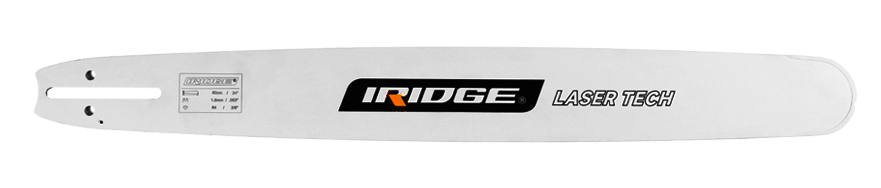
Measuring Pitch
Pitch refers to the distance between drive links and determines chain-to-bar compatibility. To measure pitch:
- Locate three consecutive rivets on your chain
- Measure the distance between the centers of the first and third rivets
- Divide this measurement by 2
- The result is your pitch measurement
Common pitch sizes include 1/4" (0.25"), .325" (low-profile 3/8"), 3/8" (0.375"), and .404". Most homeowner chainsaws use .325" or 3/8" low-profile pitch. However, this measurement can be tricky, so it's often easier to check the information stamped on your bar or consult your owner's manual.
Measuring Gauge
Gauge measures the thickness of the groove in the bar where the drive links fit. You'll need either a specialized gauge tool or precision calipers:
- Clean the bar groove thoroughly to remove all debris
- Insert the gauge tool into the groove, or measure the groove width with calipers
- Match your measurement to standard gauge sizes
Standard gauges are .043", .050", .058", and .063". The .050" gauge is most common on consumer and semi-professional equipment, while .058" and .063" gauges appear on professional-grade saws. The gauge measurement is also typically stamped on the bar near the mounting end.
Counting Drive Links
Drive link count determines the exact chain length needed for your bar. To count drive links:
- Remove the chain from the bar
- Lay it flat in a circle
- Mark one drive link with a marker or piece of tape
- Count each drive link (the smooth, flat links without cutting teeth) until you return to your marked link
A 16-inch bar with 3/8" pitch typically requires 56 drive links, while the same length bar with .325" pitch might need 60 drive links. This specification varies significantly based on pitch and bar design, so accurate counting is essential when purchasing replacement chains.
Finding Bar Specifications Without Measuring
Before reaching for your measuring tape, check these quick reference locations that often provide all the specifications you need without any physical measurement.
Bar Stamping Location
Most manufacturers stamp critical specifications directly on the bar. Look for this information in these locations:
- Near the mounting end on the side: Often shows pitch, gauge, and called length
- On the tail of the bar: May include model number and specifications
- On the drive link area: Sometimes stamped with gauge and pitch information
A typical stamping might read: "18 - .325 - .050" indicating an 18-inch bar with .325" pitch and .050" gauge. Some manufacturers use color coding—small colored dots or paint marks—to indicate gauge size, though color codes vary by brand.
Owner's Manual and Model Information
Your chainsaw's owner's manual contains a specifications section listing compatible bar lengths, pitch, and gauge. If you've misplaced the physical manual, most manufacturers provide PDF versions on their websites. You'll need your chainsaw's model number, which is typically found:
- On a metal plate attached to the engine housing
- On a sticker under the top cover
- Stamped directly into the plastic housing
Chain Packaging
If you have the original chain packaging or a recently purchased replacement chain, it displays all the specifications you need. Chain boxes clearly state pitch, gauge, and drive link count. These specifications must match your bar exactly, providing a reliable reference even if the bar stamping has worn off.
Common Measurement Mistakes to Avoid
Accurate measurement requires attention to detail. These common errors lead to incorrect bar purchases and compatibility issues that can cost you time and money.
Measuring from the Wrong Starting Point
The most frequent error is measuring from the back of the saw body or from the bar studs rather than from where the bar emerges from the housing. This adds 2-4 inches to your measurement and leads to ordering a bar that's far too long. Always start your measurement at the point where the bar becomes visible outside the chainsaw casing.
Not Rounding to Even Numbers
Some users measure 17 inches and search for a "17-inch bar," which doesn't exist in standard sizing. Chainsaw bars are manufactured in 2-inch increments for most sizes. If your measurement falls between standard sizes, always round to the nearest even number. A measurement between 15 and 17 inches indicates a 16-inch bar, while 17.5 to 19 inches indicates an 18-inch bar.
Assuming All Specifications Match Bar Length
Many people incorrectly assume that knowing the bar length is sufficient for purchasing replacements. However, a 16-inch bar might have different pitch, gauge, and drive link specifications depending on the manufacturer and model. Two different 16-inch bars are not necessarily interchangeable. Always verify all four specifications: length, pitch, gauge, and drive link count.
Measuring a Worn or Damaged Bar
If your bar tip has been damaged or shortened, measuring it will give you the current length, not the original specification. This can lead to ordering a shorter bar than you originally had. Check for signs of tip damage or professional shortening. If the bar has been modified, consult your chainsaw's manual for the manufacturer's recommended bar length rather than relying on the damaged bar's measurement.
Tools and Techniques for Accurate Measurement
While chainsaw bar measurement doesn't require specialized equipment, having the right tools ensures precision and makes the process easier, especially when measuring gauge and pitch.
Essential Measuring Tools
For basic bar length measurement, you need:
- Tape measure or ruler (minimum 25-30 inches): A rigid ruler provides more accuracy than a flexible tape for shorter bars
- Good lighting: Natural daylight or a bright work light helps you read measurements accurately
- Flat, stable work surface: Prevents the saw from moving during measurement
Specialized Measurement Tools
For comprehensive bar specification verification, consider these additional tools:
- Chain gauge tool: A small, inexpensive tool (typically $5-10) with tabs of different thicknesses that quickly identifies gauge size by fitting into the bar groove
- Digital calipers: Provides precise measurements to thousandths of an inch for gauge verification, useful if bar stamping is worn off (costs $20-40)
- Pitch gauge tool: Similar to chain gauge tools but designed to verify pitch measurements
Measurement Best Practices
Follow these techniques for the most accurate results:
- Clean the bar thoroughly before measuring—accumulated debris can add fractions of an inch
- Measure twice to confirm accuracy, especially if ordering expensive replacement parts
- Hold your measuring tool straight and level—angling can add distance to your measurement
- Take measurements with the bar at room temperature—extreme cold or heat can cause minimal but measurable expansion or contraction
Using Measurements to Order Replacement Parts
Once you've accurately measured your chainsaw bar, you need to translate those specifications into the correct replacement bar and chain. Understanding how to communicate these measurements ensures you get exactly what you need.
Creating a Complete Specification List
When ordering replacement parts, provide all five critical specifications:
- Called length: The bar size (e.g., 16", 18", 20")
- Pitch: The chain spacing (e.g., .325", 3/8", .404")
- Gauge: The groove width (e.g., .050", .058", .063")
- Drive link count: Number of drive links on the chain (e.g., 56, 60, 72)
- Mount pattern: Your chainsaw's brand and model (e.g., Stihl MS 271, Husqvarna 450)
Original Equipment vs. Aftermarket
You have two options when purchasing replacement bars:
Original Equipment Manufacturer (OEM) bars come from your chainsaw's brand (Stihl, Husqvarna, Echo, etc.) and guarantee perfect fit and compatibility. They cost 30-50% more than aftermarket options but often include better materials and construction. OEM bars typically last 20-40% longer under professional use.
Aftermarket bars from companies like Oregon, Carlton, or Archer fit multiple brands and provide good value for homeowner use. These bars meet the same specifications but may use different materials or manufacturing processes. For occasional use (less than 20 hours per year), aftermarket bars perform adequately and save money. However, professional users typically prefer OEM parts for reliability and longevity.
Verifying Compatibility Before Purchase
Many online retailers and parts suppliers offer compatibility checking tools. Enter your chainsaw's make and model, and these tools display all compatible bar and chain combinations. This method eliminates measurement errors and ensures you're ordering parts that fit. Major suppliers like Oregon's online selector tool matches over 3,000 chainsaw models to appropriate bars and chains, making it nearly impossible to order the wrong parts.
When Bar Measurements Indicate Replacement is Needed
Measuring your bar isn't just about identifying size—it's also an opportunity to assess whether the bar needs replacement. Certain measurement changes signal that your bar has reached the end of its serviceable life.
Excessive Groove Wear
If your gauge measurement shows the groove has widened beyond its original specification by more than 0.005 inches, the bar needs replacement. For example, if your .050" gauge bar now measures .056" or wider in the groove, continued use will cause the chain to sit loosely, reducing cutting efficiency and increasing safety risks. Worn grooves allow excessive side-to-side chain movement, leading to uneven cuts and potential derailment.
Rail Height Reduction
The rails (edges) of your bar should be uniform in height along the entire length. Using a straightedge laid across the bar, check for dips or low spots. If the rails have worn down by 1/16 inch or more in any location, the bar cannot properly support the chain and should be replaced. This wear pattern typically develops where the bar contacts logs during cutting—usually in the center section of the bar.
Length Reduction from Damage
Compare your current measurement to the manufacturer's specification. If your "18-inch" bar now measures only 16 inches due to tip damage, it's time for a replacement. While some shops can repair minor tip damage, reduction of more than 1 inch indicates severe damage that compromises the bar's structural integrity. Operating with a damaged tip increases kickback danger and reduces cutting efficiency.
Quick Reference Guide for Bar Measurements
Use this comprehensive reference table to quickly identify all the measurements you need and where to find them. This guide consolidates the essential information for measuring and specifying chainsaw bars.
| Specification | How to Measure | Where to Find It | Common Values |
|---|---|---|---|
| Called Length | Housing edge to bar tip, round to even number | Bar stamping, owner's manual | 10", 12", 14", 16", 18", 20", 24" |
| True Length | Remove bar, measure end to end | Physical measurement only | 3-4" longer than called length |
| Pitch | 3 rivets distance ÷ 2 | Bar stamping, chain package | 1/4", .325", 3/8", .404" |
| Gauge | Groove width with gauge tool or calipers | Bar stamping, chain package | .043", .050", .058", .063" |
| Drive Links | Count all drive links on chain | Chain package, count physically | 44-115 (varies by length and pitch) |
| Mount Pattern | Identify brand/model of chainsaw | Saw model plate, owner's manual | Brand-specific patterns |
Keep a record of these specifications in your chainsaw's storage case or toolbox. Writing them on a piece of tape attached to the saw's handle or fuel tank ensures you always have the information when purchasing replacement parts. This simple step can save you from making multiple trips to the hardware store or ordering incorrect parts online.

