

 English
 Español

Ordering the wrong chainsaw chain is one of the most common and avoidable mistakes in saw maintenance. A chain that doesn't match your bar won't fit, won't tension properly, or will wear out both itself and the guide bar prematurely. The good news is that every chainsaw chain can be identified using three concrete measurements — and once you know those three numbers, finding an exact replacement becomes straightforward.
This guide walks through how to read those measurements, what they mean, and how to use them as a practical identification chart for selecting the right chain for any saw.
Content
- 1 The Three Numbers That Define Every Chainsaw Chain
- 2 How to Read Chain Markings on Your Bar and Chain
- 3 Pitch: The Most Important Measurement
- 4 Gauge: The Drive Link Thickness
- 5 Drive Link Count: Determining Chain Length
- 6 Chainsaw Chain Types by Cutter Profile
- 7 Quick-Reference Identification Chart
- 8 Matching Chain to Guide Bar
The Three Numbers That Define Every Chainsaw Chain
Every chainsaw chain is defined by three specifications: pitch, gauge, and drive link count. All three must match your guide bar exactly. Get one wrong and the chain either won't fit or won't perform safely.
Pitch is the size of the chain — specifically, the distance between alternating rivets divided by two. It must match the drive sprocket on the saw and the nose sprocket on the guide bar. Gauge is the thickness of the drive links where they ride inside the bar groove. It must match the groove width of your guide bar. Drive link count is the total number of drive links around the full loop of chain. It determines chain length and must match the bar's specified length.
These three numbers work together. Two chains can share the same pitch but have different gauges, making them physically incompatible with each other's bars. A chain with the right pitch and gauge but the wrong drive link count will either be too short to close the loop or too long to tension correctly. All three must align.
How to Read Chain Markings on Your Bar and Chain
The fastest way to identify your chain is to look at what's already stamped on your equipment. Most guide bars have the pitch and gauge values stamped or engraved near the mount end — the section that attaches to the saw body. These numbers are usually expressed in decimal form: for example, ".325 .050" means a .325" pitch bar with a .050" groove gauge.
On the chain itself, many manufacturers stamp an identification number on the side of each drive link. This number encodes the chain type, pitch, and gauge in a brand-specific format. Oregon chains use a letter-and-number system where the number after the chain type designation indicates drive link count. Stihl chains use a similar stamped code on the drive link body. If these markings are worn off — common on older chains — you'll need to measure manually using the methods described below.
Your chainsaw's owner manual is also a reliable reference. It typically lists the correct pitch, gauge, and bar length for each approved chain specification, often in a chart format near the maintenance section.
Pitch: The Most Important Measurement
Pitch is measured by placing a ruler across three consecutive rivets on the chain and measuring the distance from the center of the first to the center of the third, then dividing that number by two. The result is your chain's pitch. For example, if three rivets span 3/4 of an inch, the pitch is 3/8".
Four pitch values cover the vast majority of chainsaws in use today:
| Pitch | Also Known As | Typical Application | Saw Size |
|---|---|---|---|
| 1/4" | Quarter inch | Small arborist top-handle saws, pruning | Very small, low cc |
| 3/8" LP | Low Profile, Picco | Homeowner use, light cutting, limbing | Small to mid consumer saws |
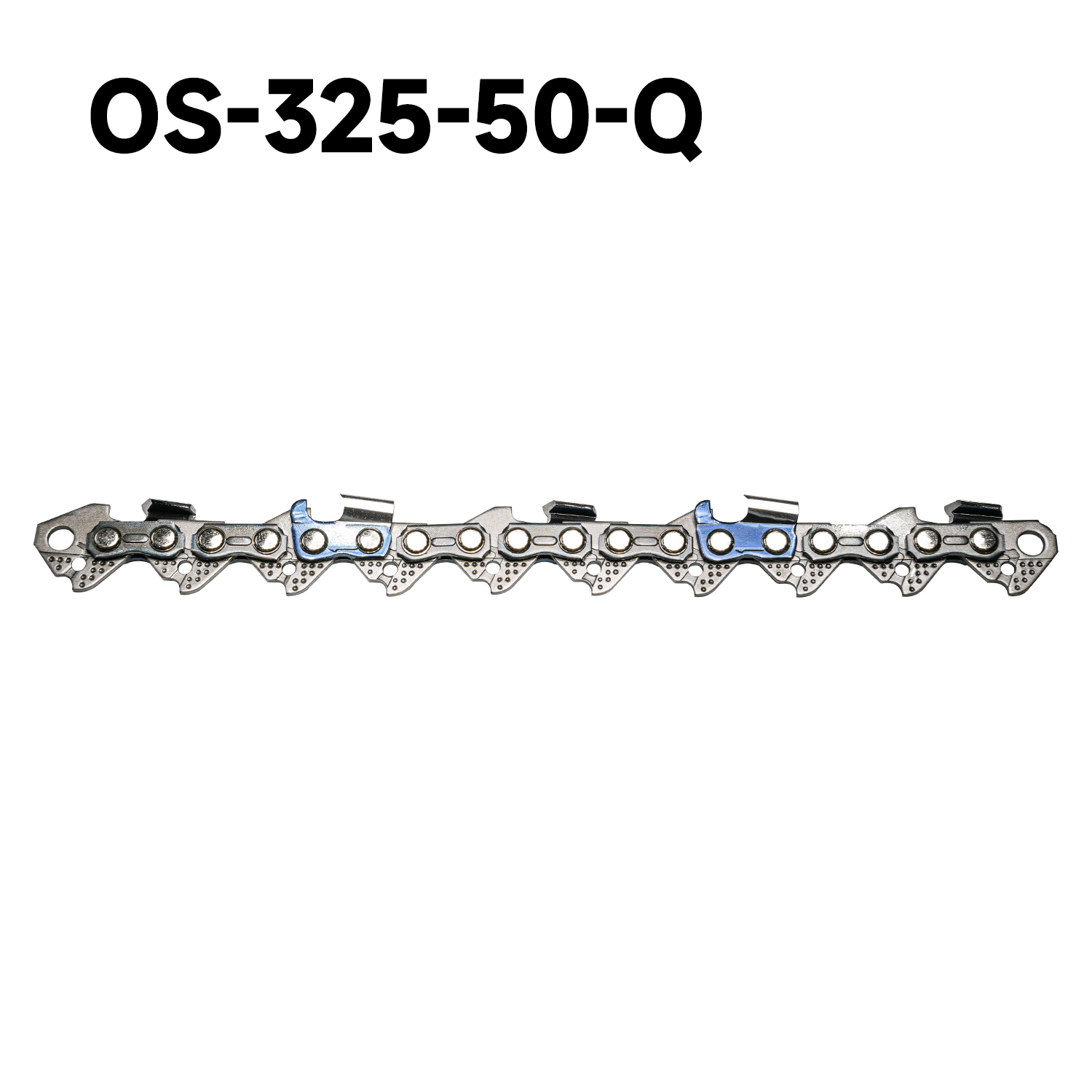
| .325" | 325 | Compact professional saws, mid-range homeowner | Mid-size, 40–60cc |
| 3/8" | Standard 3/8 | Felling, bucking, professional use | Mid to large, 50–90cc |
| .404" | 404 | Large-displacement logging, processing | Large professional, 90cc+ |
Note that 3/8" LP (low profile) and 3/8" standard are different chains despite sharing the same pitch fraction. They use different sprockets and are not interchangeable. The LP chain is narrower in profile and designed for lower-power saws; standard 3/8" is heavier and intended for more powerful machines.
For homeowner and light-duty cutting, 3/8" LP pitch chainsaw chains for light-duty and homeowner saws cover the most common consumer applications. Professional users felling and bucking larger timber typically need 3/8" pitch chainsaw chains for mid-size and professional saws, while arborists and users of compact professional saws often run .325" pitch chainsaw chains for compact professional saws. Heavy logging and processing equipment uses .404" pitch chainsaw chains for large-displacement logging saws.
Gauge: The Drive Link Thickness
Gauge is the thickness of the drive link tabs — the part of each link that rides inside the guide bar groove. It must match the groove width exactly. A chain that is too narrow for the groove will wobble and cut erratically; a chain that is too wide simply won't fit into the bar at all.
Four standard gauge values are in common use:
| Gauge (inches) | Gauge (mm) | Typical Use |
|---|---|---|
| .043" | 1.1 mm | Very small saws, low-profile chains |
| .050" | 1.3 mm | Most common — consumer and mid-range professional saws |
| .058" | 1.5 mm | Mid to large professional saws |
| .063" | 1.6 mm | Large professional and harvesting equipment |
The gauge value is almost always stamped on the side of the guide bar near the mount end. On a worn chain, measuring gauge with a standard tape measure is unreliable — the tabs wear down and give a false reading. Always use the number stamped on the drive link of your old chain, or read it directly from the guide bar, rather than measuring a worn chain. A vernier caliper can accurately measure gauge on a new or lightly used chain if no markings are visible.
Drive Link Count: Determining Chain Length
Drive link count is simply the total number of drive links in the chain loop. Unlike pitch and gauge, this number is not printed on the guide bar. The only reliable way to find it is to count the drive links on your existing chain — or look it up in a chain compatibility chart for your specific bar length and pitch combination.
To count drive links, lay the chain on a flat surface and place a small piece of tape on one link as a starting marker. Count every drive link — the tooth-like pieces that fit inside the bar groove — around the full loop until you return to the starting link. Do not count the cutter links or tie straps; drive links only.
Drive link count increases with bar length for a given pitch. A 16" bar running 3/8" standard pitch typically uses 56 drive links; a 20" bar of the same pitch uses around 72. These numbers vary slightly by bar manufacturer, so always verify against your specific bar rather than assuming a standard count by length alone.
Chainsaw Chain Types by Cutter Profile
Once pitch, gauge, and drive link count are confirmed, the remaining choice is cutter profile — the shape of the cutting tooth. This determines cutting speed, ease of sharpening, and sensitivity to dirty or abrasive wood.
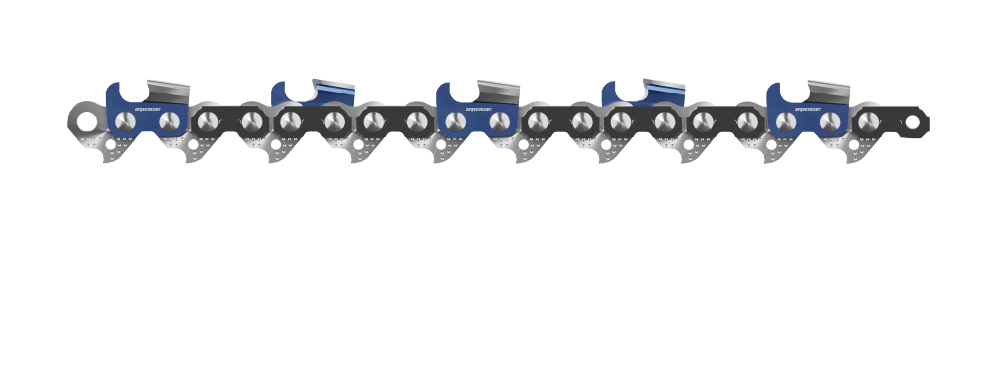
Full chisel chains have square-cornered cutters that make aggressive, fast cuts. They stay sharp longer in clean softwood conditions but dull quickly in dirty or sandy wood and are more prone to kickback. They are the choice of experienced professional users working in controlled conditions.
Semi-chisel chains have rounded cutting corners that are more forgiving in abrasive and dirty conditions. They dull more slowly when encountering grit or embedded dirt and are easier to sharpen with a round file. Most homeowners and general-use professionals favor semi-chisel for its versatility and durability across varying conditions.
Low-profile chains (also called low-kickback chains) combine a smaller cutter body with drive link guards that reduce the risk of kickback. They are standard on consumer-grade saws and recommended for users who don't have professional chainsaw training. Cutting speed is lower than full or semi-chisel, which is an acceptable trade-off for the added safety margin.
Quick-Reference Identification Chart
Use this chart to cross-reference your chain's pitch with typical gauge values, drive link ranges, and applications:
| Pitch | Common Gauge(s) | Drive Links (typical range) | Saw Type / Application |
|---|---|---|---|
| 1/4" | .043" | 60–80 | Top-handle arborist saws, pruning |
| 3/8" LP | .043" / .050" | 44–62 | Consumer homeowner saws, light limbing and bucking |
| .325" | .050" / .058" | 56–80 | Compact professional saws, mid-range homeowner use |
| 3/8" | .050" / .058" / .063" | 56–84 | Mid to large professional saws, felling and bucking |
| .404" | .063" / .080" | 66–100+ | Large logging saws, harvesting equipment |
This chart provides a starting point. Always verify against your specific guide bar markings and owner manual before purchasing, as some manufacturers use non-standard combinations for particular models.
Matching Chain to Guide Bar
Before finalizing a chain purchase, run through this three-point confirmation against your guide bar:
First, confirm pitch matches — the chain's pitch must equal the pitch stamped on the bar and must match the drive sprocket on the saw body. Second, confirm gauge matches — the chain's drive link thickness must equal the groove width stamped on the bar. Third, confirm drive link count matches — count the drive links on the old chain or use the bar manufacturer's specification for your bar's length and pitch combination.
If you're replacing a bar and chain together, the same logic applies in reverse: the new bar's pitch and gauge must match your saw's drive sprocket, and the chain must then match the new bar. Explore the full range of compatible chainsaw guide bars to find the right bar and chain combination for your saw's specifications and cutting application.
A correctly matched chain — right pitch, right gauge, right drive link count — runs quieter, cuts faster, and lasts significantly longer than one that's even slightly out of spec. The identification process takes a few minutes and saves considerable time and cost in the long run.

