

 English
 Español


The chain is off the saw and sitting on the bench next to a caliper, and the tail of the bar carries three stamped numbers, one of which has worn away. That is the moment most people go looking for help: the old chain is stretched, the part number on the box was thrown out two seasons ago, and the dealer wants three figures before handing over a replacement. Getting those figures right takes about ten minutes with a caliper and a paint pen.
The short answer is that a chainsaw chain is defined by three measurements: pitch, gauge, and the number of drive links. Pitch controls how the chain meshes with the drive sprocket and the bar nose sprocket, gauge describes the thickness of the drive link tang that rides in the bar groove, and the drive link count sets the length of the loop. Measure all three and the chain fits. Skip one and you will be back at the counter with a chain that will not seat.
Content
- 1 Three Measurements That Decide Whether a Chain Fits
- 2 How to Measure Chain Pitch
- 3 Pitch Reference: What the Numbers Look Like on a Caliper
- 4 How to Measure Gauge Without Guessing
- 5 Counting Drive Links
- 6 Cross-Check the Chain Against the Bar
- 7 When the Numbers Do Not Quite Match
- 8 Ordering With Confidence
Three Measurements That Decide Whether a Chain Fits
Pitch and gauge are the two that go wrong most often, because both are small numbers described in fractions and thousandths of an inch, and both are printed on the same bar stamp in a font that is hard to read once oil and sawdust have done their work. Here is what each one actually controls:
- Pitch: the spacing of the rivets along the chain. It has to match the tooth count and profile of the drive sprocket on the saw and the nose sprocket on the bar.
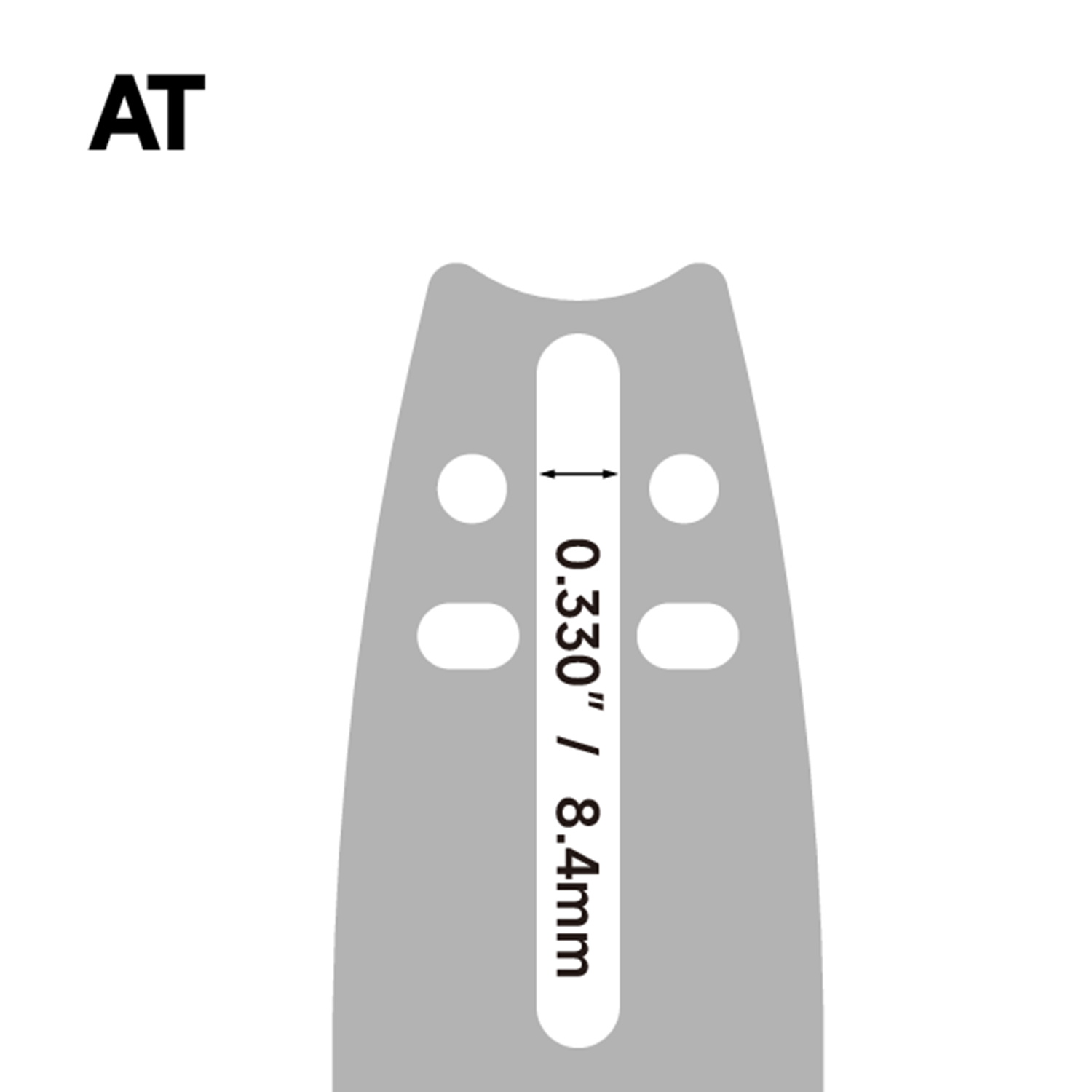
- Gauge: the thickness of the bottom tang on each drive link, the part that sits inside the bar groove. It is measured in thousandths of an inch, typically between .043 and .063.
- Drive link count: the total number of drive links in the loop, which determines the chain length for a given bar.
Two of these are usually stamped on the bar. The third is something you count yourself, and there is no reliable shortcut for it.
How to Measure Chain Pitch
Pitch is half the distance between every third rivet, which sounds awkward until you actually do it. The procedure is short:
- Clean the chain and lay it flat on a bench, cutters facing up. Grease and packed sawdust will throw a caliper reading by a few hundredths of a millimetre, which is enough to matter.
- Pick three consecutive rivets on the same side of the chain. The tie-strap rivets between cutters are the easiest to see and the least likely to be deformed.
- Measure from the centre of the first rivet to the centre of the third with a caliper, in millimetres or to three decimal places in inches.
- Divide that number by two. The result is your pitch.
A caliper reading of 0.750 in (19.05 mm) means a pitch of 0.375 in, or 3/8 inch. A reading of roughly 0.650 in (16.5 mm) means .325 inch pitch. Take the measurement at two or three points along the loop; on a clean chain the readings should agree within about 0.2 mm.
One trap catches a lot of buyers. Standard 3/8 inch pitch and 3/8 inch low profile share the same rivet spacing, so the caliper cannot tell them apart. They are different chains: low profile has a shorter cutter and a smaller drive link, and it belongs on smaller, lower-displacement saws. Distinguish them by the drive link height, the gauge, and the marking on the bar rather than by pitch alone.
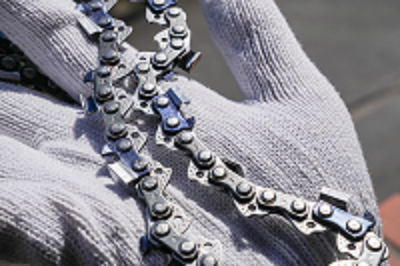 3/8-Inch Low-Profile Chainsaw Chain for Small SawsLow-profile 3/8-inch chain suited to small and home-use saws, pruning and fine cutting; verify drive-link height and bar marking before ordering.View Product →
Pitch Reference: What the Numbers Look Like on a Caliper
| Nominal pitch | Three-rivet distance | Where it is normally found |
|---|---|---|
| 1/4 in | 0.500 in / 12.7 mm | Pole pruners and small top-handle saws |
| 3/8 in low profile | 0.750 in / 19.05 mm | Homeowner and farm saws of roughly 30 to 45 cc |
| .325 in | 0.650 in / 16.5 mm | Mid-size saws of roughly 45 to 60 cc |
| 3/8 in | 0.750 in / 19.05 mm | Felling and bucking saws of roughly 55 to 90 cc |
| .404 in | 0.808 in / 20.5 mm | Large-displacement saws and harvester heads |
The two 3/8 inch rows are the reason a measurement alone is not enough. If your caliper reads 0.750 in, confirm the chain family from the bar stamp, the drive sprocket, or the old chain's markings before ordering.
How to Measure Gauge Without Guessing
Gauge is the thickness of the drive link tang, the small fin that hangs below the chain body and runs inside the bar groove. Close the caliper jaws on that tang alone. Do not measure across a cutter, a tie strap, or the full body of the link, because those will give you a number that means nothing.
- Common values are .043 in (1.1 mm), .050 in (1.3 mm), .058 in (1.5 mm) and .063 in (1.6 mm).
- If the reading falls between two values, clean the tang with a wire brush and measure again. Dried sap and burrs can add 0.02 to 0.05 mm quickly.
- Measure three or four drive links, not just one. A tang that has worn visibly thinner than its neighbours usually means the bar groove has worn with it.
The consequence of getting gauge wrong is not dramatic at first, which is what makes it expensive. A .050 chain dropped into a .058 groove sits loose, rocks sideways under load, cuts crooked and eventually throws. A chain that is too thick will not seat at all, or binds as the bar heats up. Either way you have spent money on a loop that will not do the job.
Counting Drive Links
Drive link count is simply the length of the loop expressed as a number. Lay the chain flat with the tangs pointing up and count every drive link, including the ones sitting under the cutters. Cutter teeth and tie straps do not count, which is where most miscounts come from.
Mark every tenth link with a paint pen or a twist tie so you do not lose your place halfway round. A practical shortcut: hang the chain on a nail and count in pairs, or lay it beside the bar and count both sides at once. Then cross-check against the number stamped near the tail of the bar, which is often something like 66, 72 or 78.
Do not estimate link count from bar length. Two 20-inch bars can take different loops, because nose sprocket tooth counts differ between bar profiles. The stamped number on the bar and the counted number on the chain should match exactly; if they do not, trust the physical count and check whether the bar has been swapped at some point.
 .325-Inch Pitch Chainsaw Chain for Small to Medium SawsVersatile .325-inch chain for pruning, firewood and medium wood cutting; match the bar stamp’s pitch, gauge and drive-link count when replacing.View Product →
Cross-Check the Chain Against the Bar
Modern bars carry a compact stamp at the tail that answers most of the questions at once, in a format such as 20 .325 .058 78DL. That reads as a 20-inch cutting length, .325 pitch, .058 gauge and 78 drive links. Bar length is measured as cutting length, from the tip to the point where the bar disappears into the saw body, not the overall length of the steel.
If the stamp is unreadable, the old chain is your second source of truth, provided it still fits the bar without sagging off the nose. Remember that a loose chain hammers the bar groove and the nose sprocket far harder than a correctly tensioned one, so a bar that has been run slack may need replacing alongside the chain. Details on how chain tension affects guide bar wear are worth reading before you decide the bar can stay.
 Professional Hardnose Chainsaw Guide Bar for Demanding CuttingDurable hardnose bar built for abrasive, heavy-duty cutting; check chain tension and drive-sprocket wear before fitting a replacement chain.View Product →
When the Numbers Do Not Quite Match
A worn chain measures slightly longer overall than a new one, because the rivet holes and rivets wear against each other. That stretch does not change the pitch class, so do not compensate by ordering a shorter loop. Fit a new chain to a worn drive sprocket and the new chain wears out quickly, so inspect the sprocket for hooked teeth at the same time.
Three other mismatches are worth knowing. A chain measured at .056 in usually means a dirty .058 tang rather than a rare gauge. A bar whose groove has opened up will let a correct chain wobble, which shows as crooked cuts rather than as a measurement error. And a chain that fits the bar but not the saw usually points to a mismatched drive sprocket, often from an earlier repair with the wrong part.
Ordering With Confidence
Write the three numbers down before you open a catalogue: pitch, gauge and drive link count, for example .325 pitch, .058 gauge, 78 drive links. Add the bar's cutting length and the saw model if you have them, since that combination removes almost all ambiguity when a supplier checks the order.
Buying the bar and the chain as a matched set is the safer route when either part is worn, because a new chain on a tired bar groove will wear out early and cut poorly in the meantime. Our chainsaw chain range covers the four common pitch families, and matching guide bars are listed alongside them so the pitch, gauge and link count stay consistent from the start.
Ten minutes with a caliper, a paint pen and a flat bench is all the job takes. Measured once and written down, those three numbers will keep every future order correct, even after the stamp on the bar has worn smooth.

