

 English
 Español

A repair shop orders twenty feet of 3/8-inch low-profile chain for a 20-inch bar. The pitch is right, the gauge is right, and the chain still comes up four drive links short when the rivets are spun. That one failure explains why a chainsaw blade size chart is worth keeping within reach: three numbers have to agree at the same time, and a fourth decides whether the assembly ever sits on the saw.
Pitch, gauge and drive link count belong to the chain. The mount pattern belongs to the bar. Get those four right and a 20-second check replaces a return, a re-order and an argument with a customer. Get one wrong and the best outcome is a chain that will not fit; the worst is a bar with spread rails and a chain running hot at speed.
Content
- 1 What a Chainsaw Blade Size Chart Actually Measures
- 2 Pitch: The Column That Decides Whether the Chain Runs at All
- 3 Gauge: The Dimension Buyers Get Wrong Most Often
- 4 Drive Link Count: Why Bar Length Alone Is Not Enough
- 5 Bar Mount and Tail Pattern: The Column Most Charts Leave Out
- 6 How to Verify a Fit in Five Steps
- 7 Where Size Charts Fail in the Field
- 8 Matching Bar, Chain and Sprocket Nose as One System
- 9 What to Put on a Spec Sheet When You Buy in Volume
What a Chainsaw Blade Size Chart Actually Measures
Blade is the trap word. In North America it usually means the guide bar; in much of Europe and in most factory catalogues it means the chain. Most published charts are chain charts, and the bar carries its own separate dimensions, so confirm which part a supplier is describing before reading any row.
A complete fit needs five values:
- Pitch, the size of the chain links, in inches.
- Gauge, the thickness of the drive link tang, in thousandths of an inch or millimetres.
- Drive link count, the number of links in the loop.
- Bar length, measured as cutting length from tail to nose tip, not overall bar length.
- Mount pattern, the tail geometry that fits the saw studs, oiler and tensioner.
The first three belong to the chain, the last two to the bar. Charts show them together because the two parts only work as a pair.
Pitch: The Column That Decides Whether the Chain Runs at All
Pitch is measured across three consecutive rivets and divided by two. A chain with a three-rivet span of 3/4 inch is a 3/8-inch chain. The drive sprocket and the bar nose are cut to that same figure, so a pitch mismatch is not a tight fit, it is a chain that will not seat on the sprocket.
| Pitch | Saw class | Common bar lengths | Notes |
|---|---|---|---|
| 3/8 in LP | Light to mid-size, 30 to 50 cc | 12 to 20 in | Narrow kerf, low kickback, most homeowner saws |
| .325 in | Mid-size, 45 to 60 cc | 15 to 24 in | Better chip clearance than LP at higher power |
| 3/8 in standard | 55 to 70 cc | 16 to 28 in | Common on professional felling saws |
| .404 in | 70 cc and above, harvester heads | 20 to 42 in | Heavy loads, large chips, high torque |
Two practical points sit behind that table. Low-profile and standard 3/8-inch chain are not interchangeable even though both are marked 3/8, because the LP cutter and drive link are thinner. A rim sprocket can also be swapped to change pitch on the same saw, while a spur sprocket cannot, so a switch from .325 to 3/8 standard changes the rim rather than the bar.
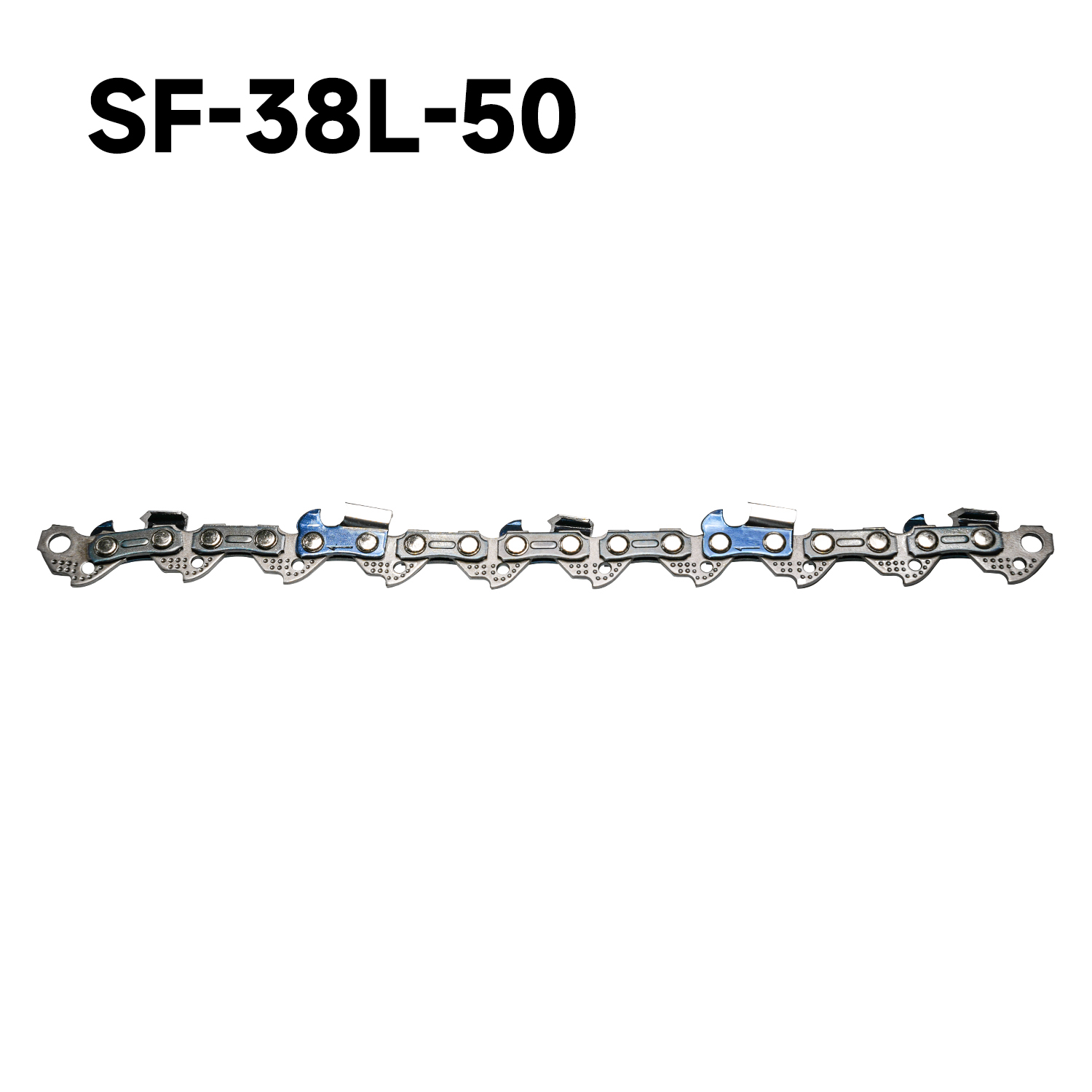 3/8-Inch Low-Profile Pitch Chainsaw ChainLow-profile 3/8-inch pitch chain for small saws, pruning, and fine cutting, with semi-chisel and full-chisel options; not interchangeable with standard 3/8 chain.View Product →
Gauge: The Dimension Buyers Get Wrong Most Often
Gauge describes the width of the slot the chain runs in, and the drive link tang is stamped to the same thousandths figure. The pair most often confused is .050 and .058, a difference of eight thousandths of an inch that is invisible on a shelf and decisive in a bar groove.
Force a .058 chain into a .050 bar and the rails spread as the tangs ride up; the chain runs hot, the groove opens and the bar is scrap. Drop a .043 chain into a .050 groove and it rocks side to side, wearing rails, drive links and sprocket together. Both failures look like a chain quality problem to the end user and are actually a specification error.
| Gauge | Metric | Typical application |
|---|---|---|
| .043 in | 1.1 mm | 3/8 in LP on small, low-kickback saws |
| .050 in | 1.3 mm | Most widely used; 3/8 in LP and .325 in |
| .058 in | 1.5 mm | 3/8 in and .404 in on mid and large saws |
| .063 in | 1.6 mm | .404 in, harvester bars, high-power saws |
Drive Link Count: Why Bar Length Alone Is Not Enough
Drive link count is where a chart earns its keep. Two bars of the same length take different loops when the pitch differs, and even at one pitch a different tail profile or nose type can shift the count by a link or two. A 20-inch bar in .325 typically takes 78 links; the same 20 inches in 3/8 standard typically takes 72.
| Bar length | 3/8 in LP | .325 in | 3/8 in | .404 in |
|---|---|---|---|---|
| 16 in | 55 | 66 | 60 | not typical |
| 18 in | 62 | 72 | 66 | not typical |
| 20 in | 70 | 78 | 72 | 68 |
One caution on measuring: a used chain has stretched, often by half a percent or more, so a worn loop laid flat can read one link long. Count the links on the new box or trust the number stamped on the bar. Tension matters for the same reason, since chain tension has a direct effect on guide bar wear resistance, and a correct link count is only useful when the chain is then tensioned to spec.
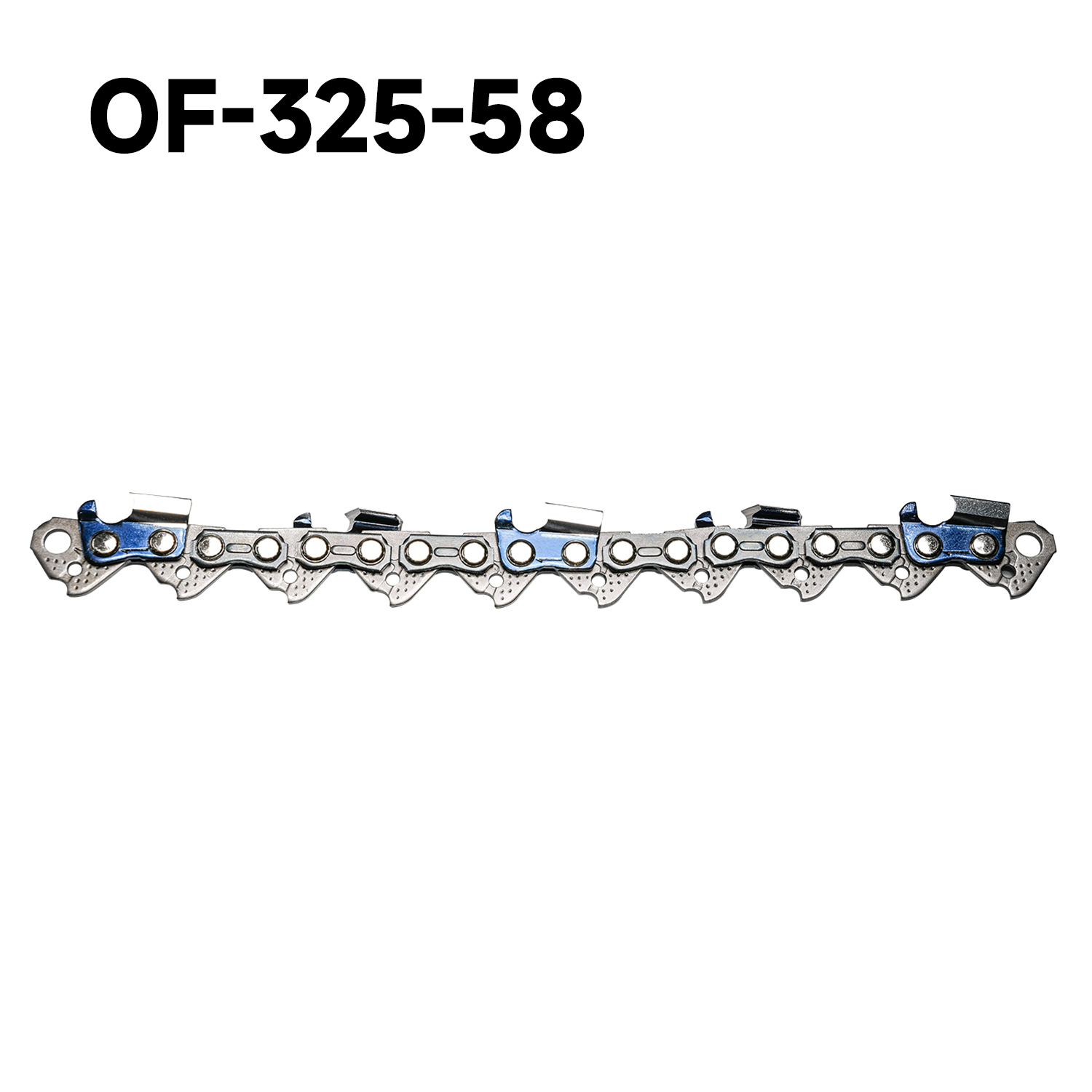 .325-Inch Pitch Chainsaw Chain for Small to Medium SawsMid-range .325 pitch chain for medium wood, pruning, and forestry work; available in semi-chisel and full-chisel configurations with optional skip cutters.View Product →
Bar Mount and Tail Pattern: The Column Most Charts Leave Out
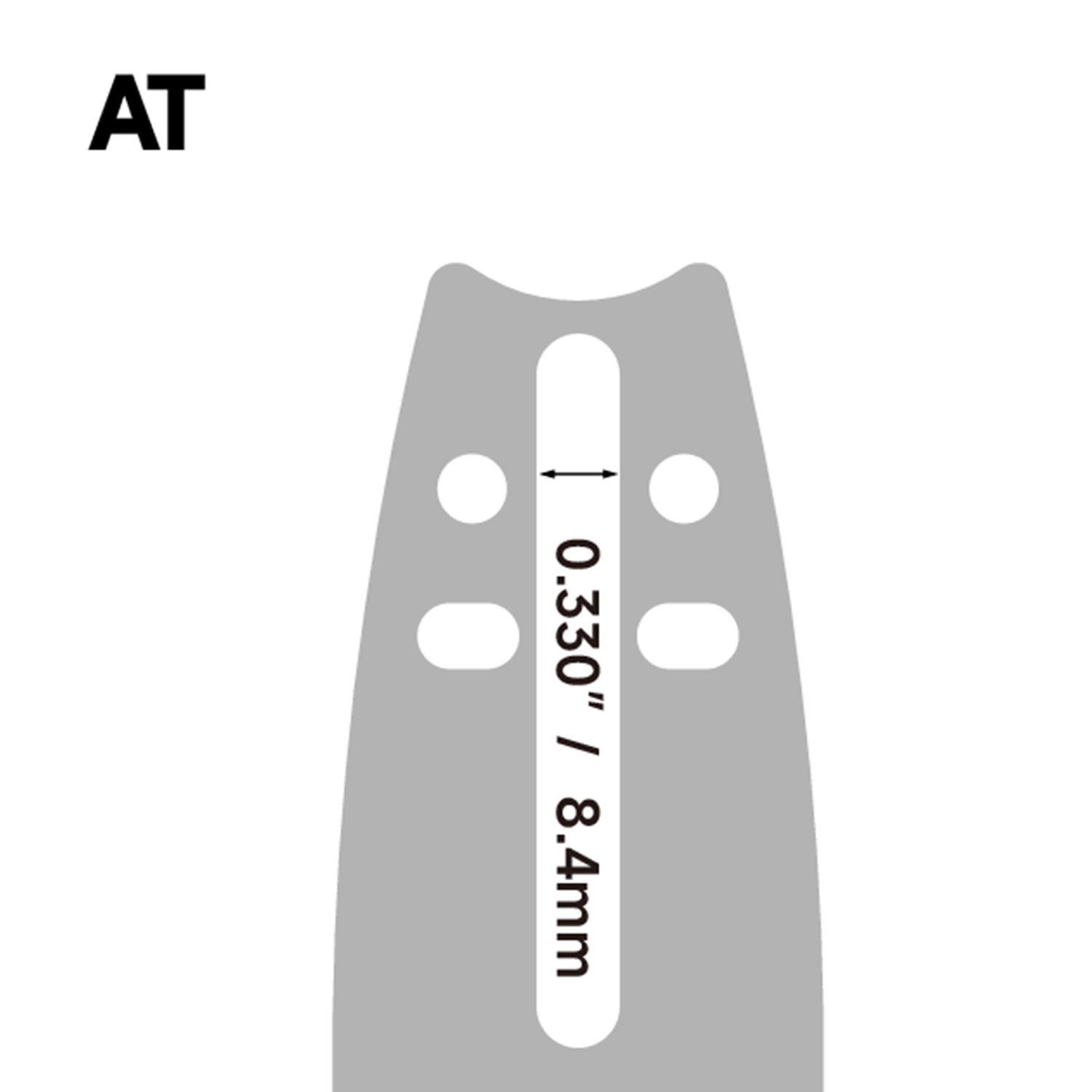
Pitch and gauge can be perfect and the bar will still refuse to bolt on. Mount patterns are identified by a manufacturer code, and each code bundles slot width, stud spacing, oiler hole position and tail shape. A bar with the right length and the wrong code either will not pass over the studs or sits on the saw with oiler holes misaligned, which starves the chain of oil within minutes.
Because mount kits are proprietary, the fastest confirmation is to copy the code from the old bar and check it against the supplier table rather than measuring the tail by hand.
 Professional Hardnose Chainsaw Guide BarStellite-nose guide bar for professional arborists, loggers, and abrasive cutting; heat-treated body and lubrication design suit demanding forestry and construction use.View Product →
How to Verify a Fit in Five Steps
- Read the bar stamp. Length, pitch, gauge, drive link count and mount code are usually etched or punched near the tail.
- Measure the gauge if the stamp is gone, using a micrometer or gauge tool on the drive link tang rather than the cutter. Tolerance runs to a few thousandths, so a rule is not good enough.
- Count drive links on the replacement chain, not on a worn loop.
- Check the drive sprocket. It must match the pitch, and a 7-tooth or 8-tooth rim changes chain speed and available torque even though the link count stays the same.
- Cross-check the row where pitch, gauge, bar length and drive link count meet, then confirm the mount code in the same table.
Where Size Charts Fail in the Field
- Counting a stretched chain. Half a percent of stretch on a 72-link loop is enough to push the count to the next link.
- Reading .058 and .063 as the same size in poor light, then mixing them and ruining both parts.
- Assuming a 20-inch bar is a 20-inch bar, when the same length can take 70, 72 or 78 links depending on pitch, nose type and tail.
- Forgetting the nose, since a hardnose and a sprocket-nose bar of the same length often differ by one link.
- Buying chain before confirming the saw class, because the types of chainsaws and saw chains on the market are the reason no single chart covers everything.
Matching Bar, Chain and Sprocket Nose as One System
A cut is a system, and the size chart is the interface between its three wearing parts. Chain pitch and gauge must match the bar groove and nose sprocket, the mount code must match the saw, and the link count must suit the bar length and pitch. Replace one part without checking the other two and the mismatch shows up as heat, vibration or rapid rail wear rather than as a part that will not fit.
That is why repairable bars exist at all. On a sprocket-nose bar the nose is a wear part, so fitting a new nose restores the fit and keeps the same link count instead of scrapping the bar. Hardnose bars are not serviceable at the tip, which makes the count worth recording while the bar is new. Harvester guide bars follow the same logic at a larger scale, where loads are higher and a count error costs a whole shift.
What to Put on a Spec Sheet When You Buy in Volume
For a workshop or an OEM buyer, the chart becomes a purchasing document rather than a counter reference. A workable chain order states, at minimum:
- Pitch and gauge written with decimals, for example .325 in and .050 in.
- Drive link count, with a stated tolerance for the assembled loop.
- Mount code and bar length, so bar and chain arrive as a matched set.
- Cutter type, chisel or semi-chisel, which changes cutting behaviour more than any chart entry.
- Sprocket nose tooth count where a sprocket-nose or hardnose bar is involved.
- Packaging that keeps pitch and gauge labels visible, because mis-picking at the shelf is the most common failure in the chain of custody.
Suppliers who control heat treatment and rail machining hold these figures consistently between batches, which matters more than any single specification value. Iridge has built chainsaw guide bars and chains around 24 years of heat treatment experience, and applies the same discipline to replacement sprocket noses, lawn mower blades and harvester bars.
A chainsaw blade size chart is a short document: pitch, gauge, drive link count, bar length, mount pattern. The work is in reading all five from the same row, and in treating bar, chain and nose as one assembly rather than three parts that happen to share a shelf.

